
HIGHWAY 38 – MAN’S ATTEMPT AT A SOCIALLY BALANCED COMMUNITY IN THE AGE OF THE INDUSTRIAL REVOLUTION
The Paris Commune:
This was the first real attempt of an urban city industrial state to be united as one ruling social order of equals.
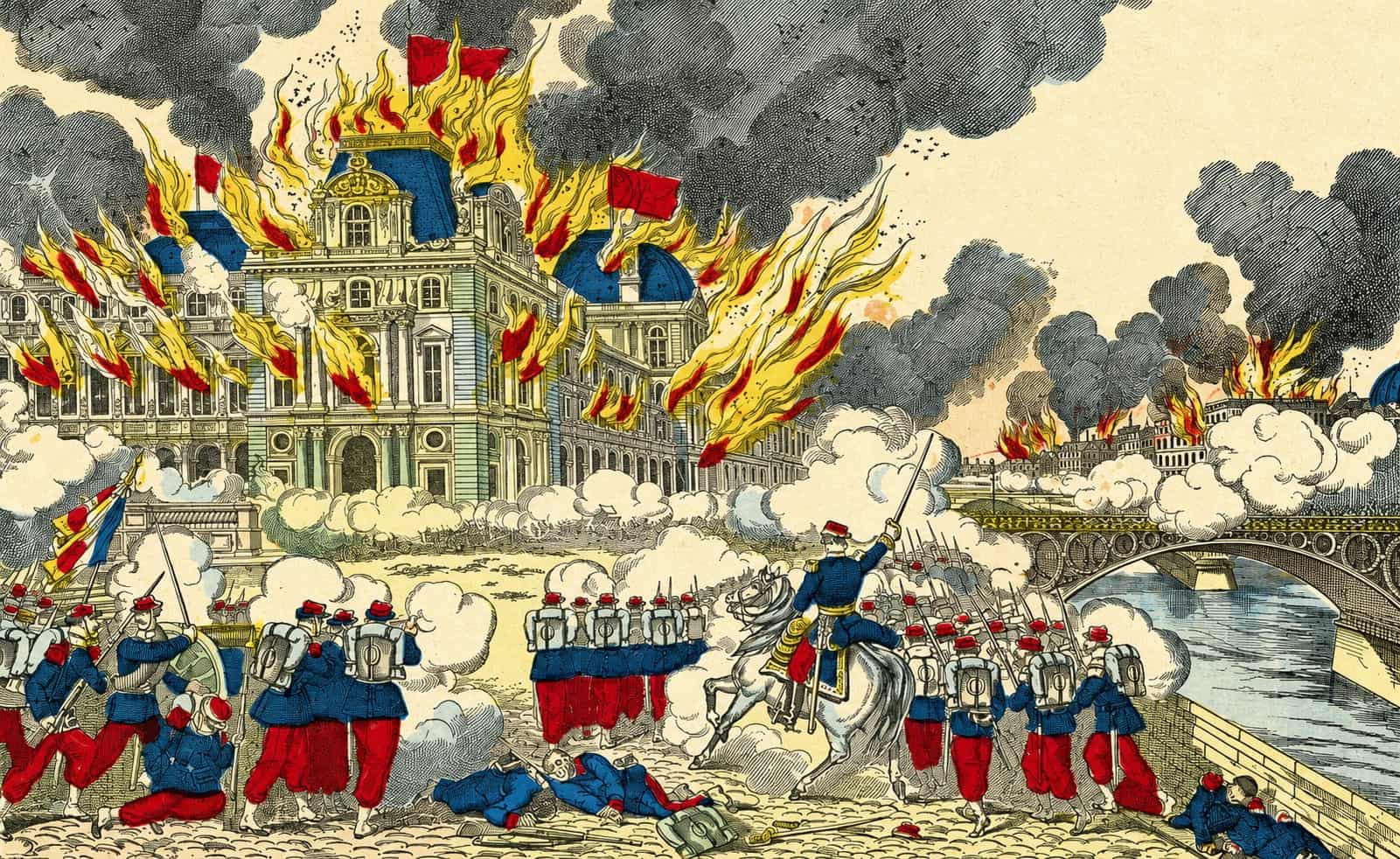
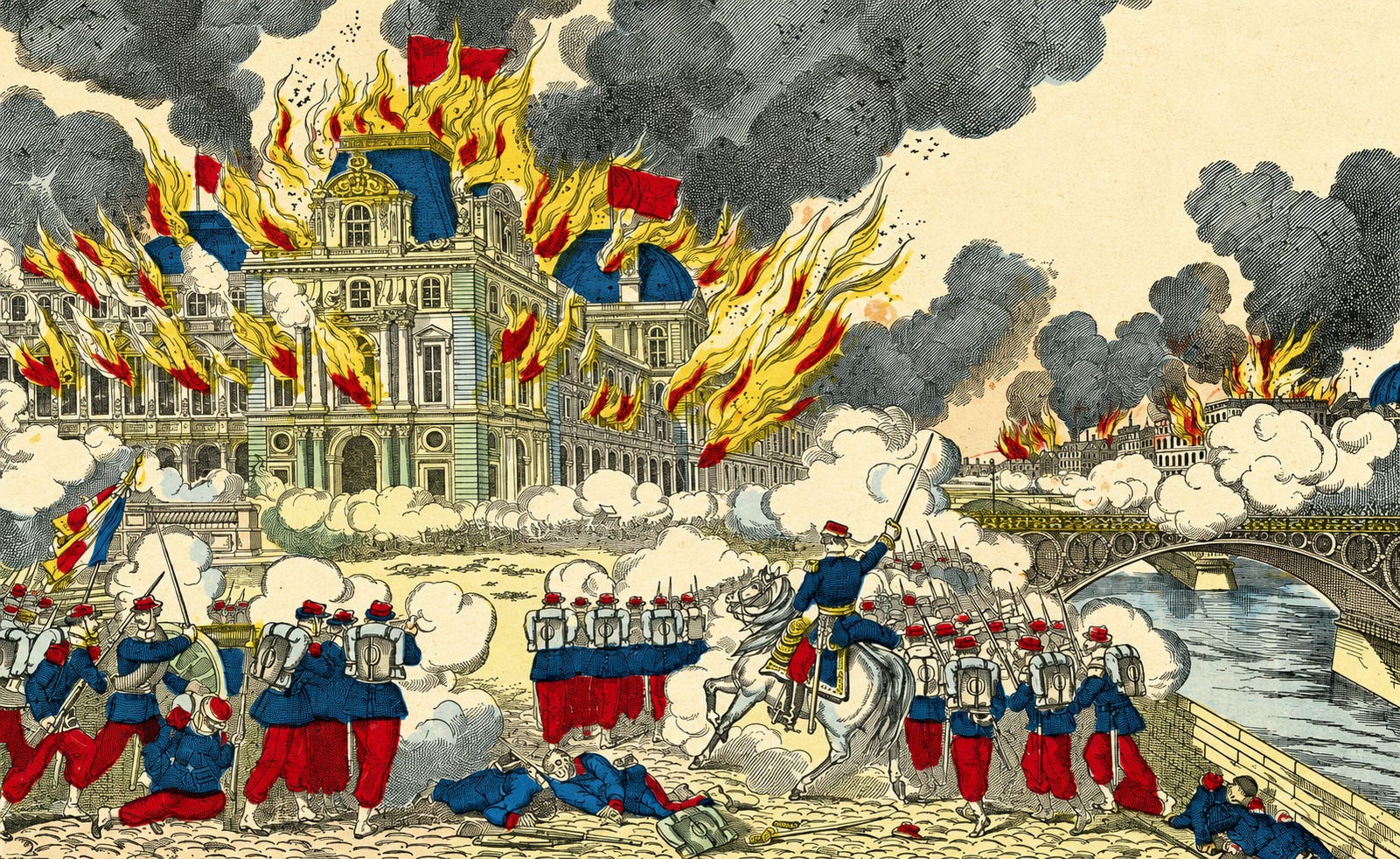
The Paris Commune was a ruling body trying to create new order for the city of Paris after the war with the Prussians, now Germans, and the removal from office of the Emperor Napoleon III. This group ruled Paris for a few months in 1871. In those few months, changes were made to the then-existing rules of order. The combined Marx-Anarchist order, as history labels them, induced a fear that these types of orders were wrong and destined to fail. In their few months of rule, they implemented changes for common Man that today we still need to put into practice to enable the world to be in a good order; an order that the people agree to be bound to without the control of a ruling force.
First, in a new order, you must get rid of the farce, the Pharisees and their imaginary rules to perpetuate the fear of the unknown. The answer they sell to control is Sky God – religion. To do this, you must erase state-sponsored Sky God. However, you must allow those who so need voodoo fix to go and get it at a non-state-sponsored church.
In this Communard, changes happened when the real separation of church and state began. The Communard separated the Church from the state by making the Church’s property state-public property. The new order excluded the practice of teaching and preaching Sky God at the state schools. Churches were allowed to continue their practices of services only if churches kept their doors open to public political meetings during the evenings. The churches and the coffee shops (before Starbucks, they did exist) became the centers for political discussions and activities.
The Commune also struck at the Sadducees’ rules of banking-controlled order. This was the theft from fellow man by those not ready to join Man; this distorted group of men believed they must own & control fellow man by the lie of currency.
To start the removal of this cancerous thought of man, the Commune did the following to the Sadducee orders of control and rule: postponed the commercial debt obligations, abolished interest on debts and implemented a policy that if the owners deserted a business, then the workers could take over the business and run it as long as the owner got some agreed compensation. Sounds like a workers’ paradise?
It may have been. The problem was the workers were not unified by an Essence and they were scared of the change they so wished to implement. For the one thing the people should have done then and there, but which they chose not to do, was take over the banks and make the bank the community asset.
The Communards did not finish off the old ruling control of life – this control was the Bank. The Communards had the chance to take over the National Bank of France located in Paris. They could and should have nationalized the bank, and made the bankers paid state employees of the Communard. There were billions of francs stored at this bank. The Communards were so afraid of a change in their real living order of control that they confirmed the bank’s position of power and control by asking the bank to borrow money to continue and finance their fight.
The bank, like all good Sadducees obliging to the rules of order & control, lent the leaders the money required to continue the fight. The loans gave the bankers control. Just as they do today.
The Communards did, however, take over the Paris mint. They issued a five-franc coin, which still exists today. The Communards chose not to take over the bank and seize the bank’s assets because they thought the world would condemn them for doing just that. So although the bankers lent the Communards money, this peace offering allowed the bankers to get their monies out and down to Versailles, where the new governmental order of the Third Republic stood ready and able to fight.
This inflow of francs to Versailles allowed the armies to be paid in a currency they accepted and therefore gave value and continued their fight and eventually would destroy the Paris Commune.
In retrospect, this community should have worked; it should have been the new order for fellow man. However, it was not to be at that time. The reasons this movement failed were at the center of dispute when the Marxists regained their lead and control of the workingman and the intellects that so wished to create a world of peace. These were both divisions of thought, each trying to take control as opposed to sharing.
Marx, in his pamphlet The Civil War in France (1871), praised the Commune’s achievements. He described their rule as the prototype for a revolutionary government of the future when the workers would finally be emancipated. His fellow thinker, Frederick Engels, at first agreed, but later wrote that the absence of a standing army, the self-policing of the quarters and the other community features of control of an order were missing, and therefore it would be impossible to be sustained.
He believed in a ruling and controlling central order. He wished for the first dictatorship of the proletariat. But as we saw with Russia, any social order of control becomes a ruling order of the few and not of the all.
Both Marx and Engels thought control was and shall always be the order of man. To control, you need manmade rules. These rules, by definition, which need force to be followed, can never be the true rules to guide and perpetuate the orders of man.
The Parisians at this point in time did not have the will, the internal fire to continue the fight. They asked for something that they as a group were not able to live, as well as protect a world of equal social order.
Marx and the other order of loose central control called Anarchists split over the results of this battle. There was a convention at The Hague called the Hague Congress of 1872. Marx started preaching in line again with Engels that the Communards failed because the workers did not deal more harshly with the reactionaries against the Communards’ new order.
Marx felt the Communards should have started their own war/army inscription and centralized all decisions in a decision-making authority which would implement the rules to perpetuate the order and create the control of the new workers’ state.
Marx really did not believe all men were equal. He believed all men needed to be ruled by a physical force of control, in essence the Communist State we are about to meet, which was the Russian reaction to their losing the war against the invading and killing German Empire armies in 1917.
The Anarchists were an anti-authoritarian group. At this convention, they were against the now-known Communist request for central controls. The Anarchists wanted a general strike of the workers and had no need for central controls. They wished for an immediate dismantlement of the state through the construction of decentralized worker councils, as those that existed in the Paris Commune.
The Commune lost when the French Republic attacked Paris. The Republic’s rallying cry was “rules, order and security shall be returned.” The French national government was able to control the media and stopped information from leaking out to the other regions of France. So support was limited.
The Sadducee French army was able to finally break into the area of the city walls. Then a guerrilla street fight ensued district by district. The fact that only a few years earlier Napoleon III had the city builder Haussmann renovate Paris to enlarge the city streets, which allowed the army to march in and gain control of the areas that were once pedestrian; now horses and buggies, as well as marching, riding armies had access. The gig was up. The social equal rule of common Parisian Man was over.
The leader of the French army that stopped the revolt was a man known as Adolphe Thiers. In his published pleas to the citizens of Paris, he referred to the Communards as Communist. This change of verbiage shows the power of words.
This new word Communist thereby took out the social underpinnings of the symbol and created the concept that socialism is bad, because it is a thought-controlled science and wrong process that lacks merit for those who wished to grow and could only grow in a land where bankers’ illusionary gates controlled your dreams.
To bring in the new, we need to rid ourselves of all symbols of the old ruling regimes; those symbols that instill thoughts of fear by writing history as though to share is wrong. We need to educate and eliminate all those fears of inequality. Then this society should allow each citizen to grow and become all they can become, as long as there are certain rules, which stop people from stealing, killing and destroying our ways and means.
To make sure the others of the land understood what happened when fellow man asks for an order of equal order & rule, the new existing killing order declared that the Communards were a committee of murderers and a pack of scoundrels. “At long last the government of crime and lunacy is rotting behind the firing squads.” This is a quote from the Frenchman Émile Zola.
The prisoners who ran this commune were exiled from the land. They were sent to New Caledonia, an island in the South Pacific, the prisoner island of French choice. The French did not understand that thought was a common occurrence amongst man, and that this thought was in the air; soon it would return with or without those failed leaders. The experiment to share failed, as the people so wishing to share were not ready to step up to the plate and take common control.
The prisoners became the source of inspiration for those who could still dream and write their dreams of a better and more loving society. Those prisoners did not all die there, and one in particular, a woman known as Louise Michel, would become one of the learned examples of peace and loving womanhood. She was an ace and she never quit. Man needs to sing her praise and teach our youth what she was and what she shared. She never quit and never gave up the hope that the world could become a better place for Man.
When she arrived in this island prison, she wished to know who lived on this island of the South Pacific. Her fellow exiles told her that the inhabitants of this island only knew how to eat flesh. She rejected this thought as man is man and we shall help fellow man.
She learned the language and became a friend. The islanders, as she later told, started sharing their pain and asked her why she was sent to this island. Did she kill her husband? She told them the story of the Communard. She says later after they helped her escape the island and heard her saga they said to her, you too are one of us: the vanquished. One day the vanquished will inherit the Earth. As we are all the vanquished until we all understand that man is all the same. One doesn’t need to beat another to win. We can actually choose to all win if we believe we are one.
France and England too were the then home of intellectual Man. Bankers did not control the schools of education. You were allowed to dream, just not live it. But there were some intellects that were able to evolve and dream of a new world and write about what they saw.
A great example of the evolution of man is Victor Hugo. The Frenchman Victor Hugo had a long revolutionary life. He was a Monarchist and he was a Republican. His books embodied the ideas of the French Revolution of 1789. He wrote of freedom, brotherhood and equality. He wrote of the hunchback of Notre Dame, who stole out of hunger and in this story you feel the pain of man in hunger and so afraid of the way he looks. You feel compassion, warmth and you feel empathy for fellow man. But those are novels…
In this era of revolution, Hugo was nearly alone in condemning the repression of the enlightened Communard. But before that, he was among the many that applauded the conquest of the African lands. This is inconsistent and we must accept that we are all one, not just the whites, but all of us.
Hugo called the conquest: civilization marching against barbarism. “It is an enlightened people setting out to meet a people living in darkness. We are the Greeks of the world, we must enlighten the world.”
So now the concept of Nation, the team sport of Europe, was in control and the next fifty years would be a battle to see which nation or group of nations with a common set of rules for order & control to own and not share would become the new Sadducee world order, with or without a Sky God.
This essay is excerpted from Steven Machat’s Highways of Man. Learn more about the book at StevenMachat.com.