
HIGHWAY 33 – THE US PEAKS & VALLEYS TRYING TO PUT TOGETHER A WINNING SOCIETY
The US & Europe During the Napoleon Wars: 1800–1812
We were involved despite the warnings of our now-dead god Washington in these European family affairs. We were involved because the two principal warriors, France and Britain, brought their communities’ disorder to us on our joint travel highways of seas and then on our lands.
Jefferson, of the Declaration of Independence fame, as well as President number three of the Constitution of 1789, actually bought from Napoleon the land on our continent so claimed by the French in 1803. It was the Louisiana Purchase that made the US the continental and world powerhouse it is today. The same land had just been granted back to the French from the Spanish in 1801.
Those in control thought the land was barren; there were only Indians who lived there who could be moved whenever and wherever they wanted. This meant this land could be built the Protestant way with hard work and open territory so Sadducees and Pharisees could believe their thoughts of rule, God of the Sky or bank of the land, were in control. The puzzle of the pieces for the US to win and control the comfortable living zones of North America was in play. Mexico was hot and barren, as was Canada, too.
We as a nation had no money to buy this land, which would help Napoleon finance his own war games on the continent. So how did the Louisiana Purchase happen? Well, we borrowed the money and became a debtor nation. Remember, our Constitution, or law and our order, did not provide for any right to purchase territory and thereby reduced the rule of the current states of our land.
Jefferson actually bought this land, thinking that yes, it may be unconstitutional, but it was really too desirable to pass up. So forget the law of the land; to have only Americans in control of the Mississippi and the port of New Orleans was what shall be. The British would have ideas on this port, too. Napoleon actually said at the time of this sale, “This accession of territory affirms forever the power of the United States, and I have given England a maritime rival who sooner or later will humble her pride.” Maybe he was a prophet, or maybe he just really hated Britain and wanted to provide a massive thorn in her side.
But how the actual purchase came off was outrageous and really teaches us what Sadducees do, how their loyalty is only to the material thoughts that the Sadducee/Bankster wishes to win and control without any morals or values. The bank that sold the territory known as Louisiana was Barings Bank, located in London, UK. The French, led by Talleyrand, tried to stop the sale, but Napoleon was in control and needed the money. This bank lasted until 1995 and was then the oldest merchant bank of the UK. It began in 1762.
The British merchant bank, which was protected by the British flag, the soldiers and the others who would give their lives fighting the French, was so rejuvenated by this purchase. This banking house financed the purchase, which resulted in the French having money to buy the supplies needed to continue their war effort against the BRITISH land so protecting Barings and their bank. The Brits gave the French, by this funding of the purchase deal, the monies to buy guns and kill the Brits then at war vs. Napoleon’s armies. Crazy? No, it is just what Sadducees do. They sell and couldn’t give a damn about anyone but themselves. There is no consciousness in a broker or a banker for anything but their own ego.
This deal was done as follows: the US put down a 3-million-dollar down payment in gold, and the remainder of the purchase was made in US bonds, which Napoleon sold back to Barings at 87.5% of the par value of the bonds. France and the US stopped fighting, and Napoleon knew the British would go to war to get this land back for their rule. So this move in the war game of chess was brilliant, as this was exactly what the British did. However, the outcome of the war of the US and UK in 1812 did nothing to change the fortunes of Napoleon in his war games in the end. For both he and the British lost big in 1815.
The US & British War of 1812
We are still fighting it in the USA. Every time we hear our “Star-Spangled Banner,” it reminds our ancestors about this war. For that song sings of the day after we got beat the night before in the harbor of Baltimore. We were still there to fight again that new day. We would not give up, and with that might, we carried on to win and keep our country from reverting back to Parliament in the UK.
The US declared this war, and the British gladly fought it. This was really the war that gave the Americans their true independence from British rule. We were a struggling nation who was trying to find our own path. The US had problems with both the French and the British. They ignored the sovereignty of the states and the property of the people of the states on the seas and the land. Remember, you need to believe you are in control, and others must also believe that you are in control, if in fact you are in control. We, the US, in this time period were definitely not in control.
The French-US differences we finally settled with the business arrangement of the Louisiana Purchase. For this deal meant the French accepted us as an equal sovereign nation, at least as equal as they would ever admit someone not French is capable of becoming.
The British did not consider us any equal. No, we were still their children. They were still playing the impressment game of commandeering sailors from US merchant ships and making them sailors of the Royal Navy. The British were also instigating the American Indian tribes to prevent American colonial expansion into what was called the West, the regions around the Great Lakes of our continent. America’s honor was at stake, and we had enough, so we declared war.
The war was fought in four theatres: one on the open seas with the merchant ships; the second, on our coastal ways, where the British blocked our coast and huge naval battles became the military rule. The British actually burnt down our capital in DC, which is on a waterway, but lost the battle of the Baltimore region, and it was in this theatre of the war that, to this day, we sing about in our “Star-Spangled Banner.”
The third theatre was in Upper and Lower Canada. We lost our way here on those fronts. The fourth was, just as Napoleon predicted, the Gulf of Mexico.
The outcome was a peace. The British kept their Canada, and Canada had acquired its national identity as a land that fought off the States. Canada remained part of the British Empire, soon to be a Commonwealth land. This concept the British created so they no longer had to pay for the local upkeep, just took what they needed from the foreign lands when their Sadducee orders wanted it for personal gain.
The Gulf, well, Napoleon was right. The British wanted this port of Orleans, and when they finally subdued Napoleon the first time in 1814, the troops were sent to the Gulf to fight to get this port.
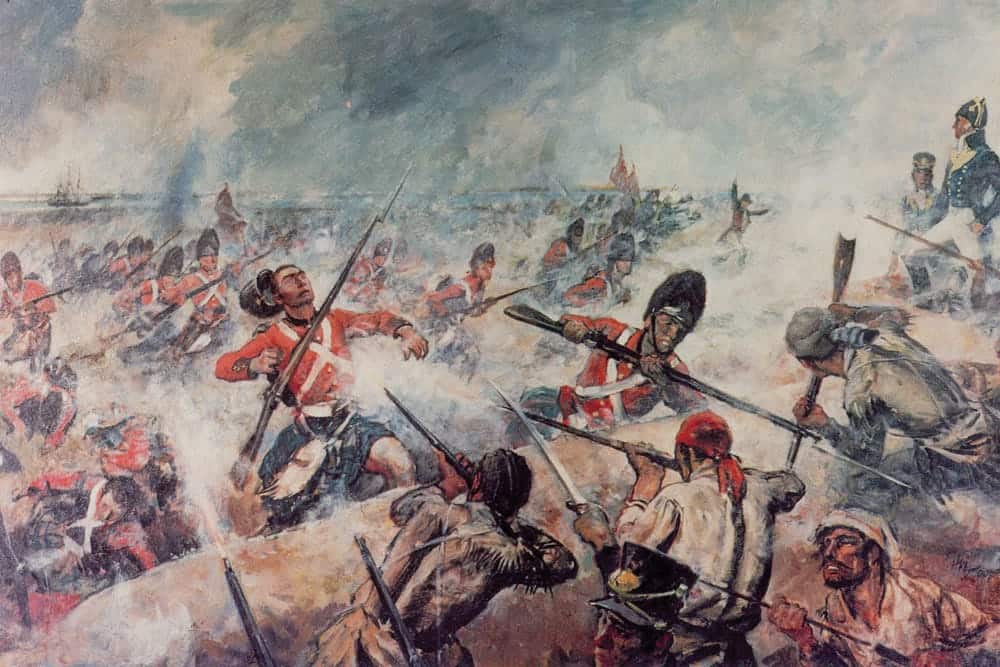
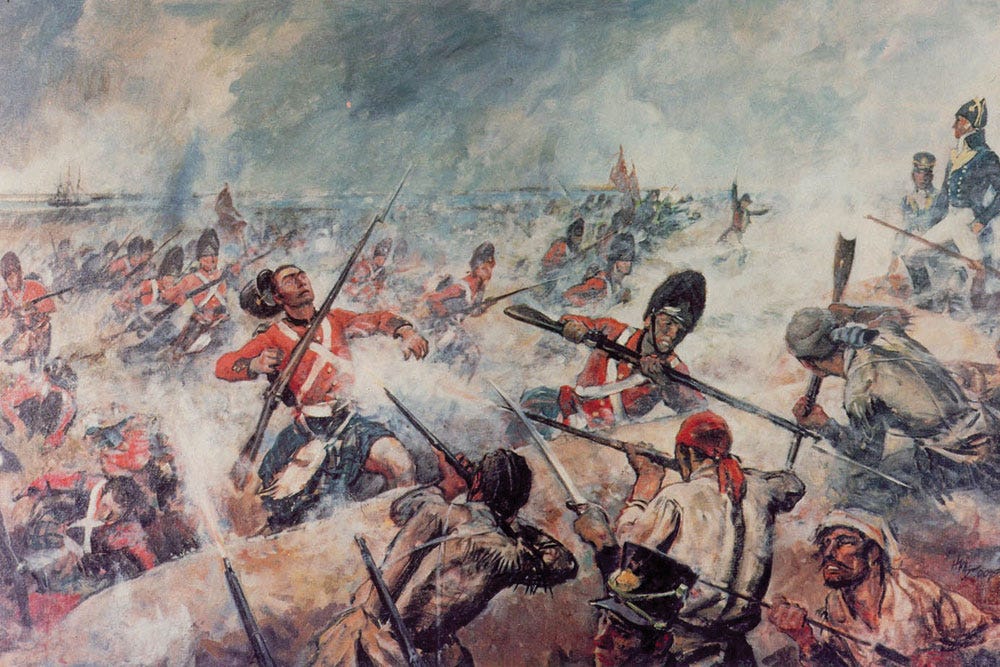
The Battle of New Orleans made a hero of the Native American Indian killer Andrew Jackson, and it is one of the great American military victories of our history. The problem with the ensuing deaths of this battle was the War of 1812 had ended in 1814. So why did we fight? Because communications took time to travel land and sea, no fighter then and there knew in this Battle of New Orleans that the fight was an exhibition of sorts, as peace had been declared at the Treaty of Ghent, which the treaty was signed at the end of the year before this battle. This meant that there was no war between the two nations.
If people understood the only victory of war is to create a new social order, one that has the power to make the old orders listen and not have war as any resort.
What these War of 1812 treaties did do was to make the British accept that we, the United States, were an independent nation. We were independent in thought but not in reality, as the British and we have the same legal system and the same language. We have property as our King and not the Napoleonic Codes, that is, except in the state of Louisiana and, to some degree, the states we stole from Spanish laws (such as California, Arizona and New Mexico, as well as parts of Colorado) still in existence in the independent country called Mexico, who had gained their own freedom from colonial Spanish rule, but not the Pope, in 1823. For the Pope to this day rules Mexico, where abortion and childbirth control are still outlawed by both the Church and the State.
This Spanish property came to us when we invaded Mexico to get the rest of the continental pieces so missing to complete our land grab in 1848. You see, the Louisiana Purchase of 1803 was not final, as the boundaries of the purchase from France were not defined, as in the deed we bought from the French didn’t have the boundaries clearly defined in the 1801 transfer from the Spanish to the French.
Confusion by design or by sloppiness is still confusion; it must be corrected, or war will ensue when two competing desires are fighting over the same contractual clause. My whole life has been involved in small individual fights as to who owns what and why in the land of Intellectual Property; the concept that you cannot touch but you can feel the ownership of thoughts not yet reduced to real property. Something you can touch and hold.
One last thought to share on Napoleon and his legacy. Haiti. This land was granted its colonial freedom from France by Napoleon in 1803. It became the first independent nation in Latin America. These countries that do not speak English as their first language are defined as Latin Americans. This term was coined when the French, so then ruled by Napoleon III, and the Austrians tried to engage the Western Hemisphere to make war against us during the US Civil War.
The French had their puppet regime ruling Mexico until May 5, 1867, when the Archduke Ferdinand Maximilian Joseph of Austria was caught and executed, and Mexico went back to their home rule.
Haiti was also the first Black-led republic in the world when it gained its independence as part of the successful slave rebellion of 1804. Haiti is the poorest nation in the Americas, and it is the land where I shall begin the next section called slavery.
This essay is excerpted from Steven Machat’s Highways of Man. Learn more about the book at StevenMachat.com.